6
3 tails
×
Changing yin
Moves in the resulting hexagram
Three coins, six tosses, one hexagram. This guide shows exactly how each toss becomes a yin or yang line — and how 6 and 9 create movement in your reading.
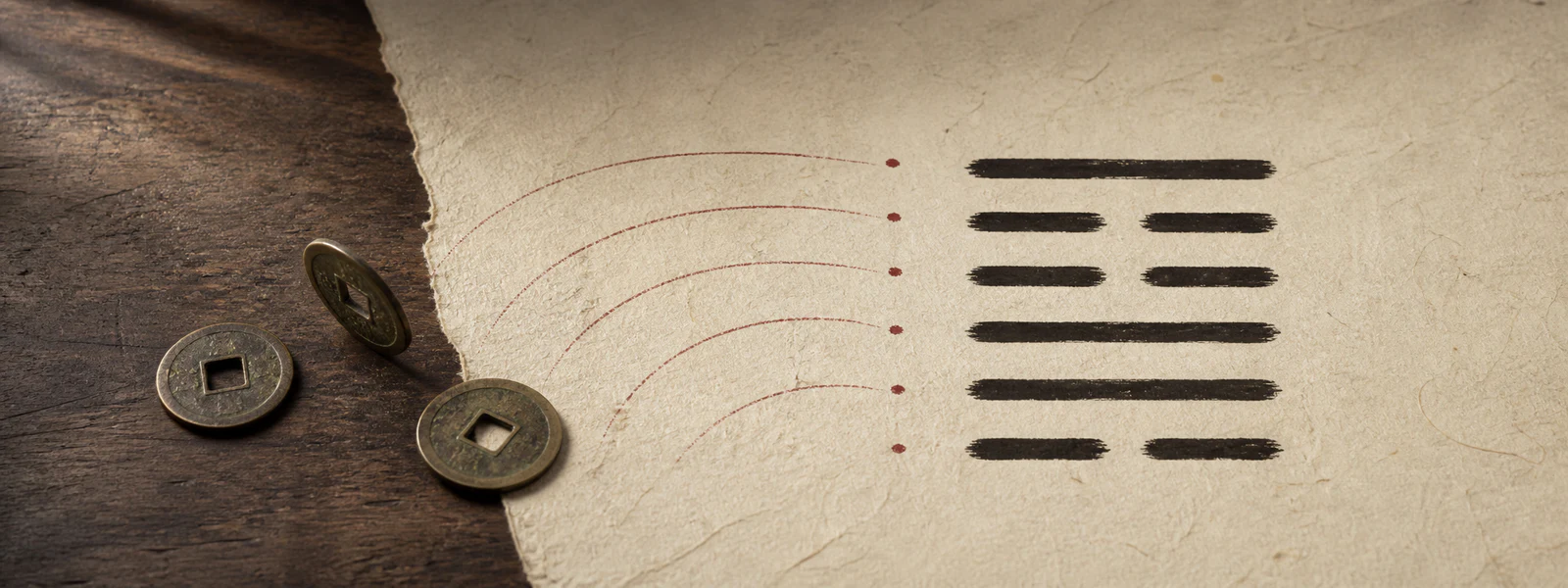
You do not need antique Chinese coins, a special cloth, or a memorized ritual. Three coins of the same type, something to record six results, and one focused question are enough.
Before the first toss, decide which side you will call heads and which side you will call tails. This guide uses heads = 3, tails = 2. Some books label or assign the two sides differently, so keep one convention unchanged through all six tosses.
If your question is still vague, shape it first with our guide to asking the I Ching a clear question.
Name one real situation. Avoid bundling several decisions into a single cast.
Let the coins settle naturally, then record each side before touching them.
Every toss makes one line. The first line belongs at the bottom.
In the convention used by 6 Tosses, heads is worth 3 and tails is worth 2. Add all three coins; the total is always 6, 7, 8, or 9.
Add the values of the three coins. An odd total is yang, shown as a solid line. An even total is yin, shown as a broken line. Under this convention, the two extremes — all tails or all heads — are changing.
Moves in the resulting hexagram
Remains unchanged
Remains unchanged
Moves in the resulting hexagram
This is an easy step for beginners to reverse. The I Ching builds from the ground upward: toss one is line 1 at the bottom; toss six is line 6 at the top.
For this example, the recorded totals are 7, 8, 9, 7, 6, 8.
The interface shows line 6 at the top, but the casting sequence began with line 1 at the bottom. Mark every 6 and 9 as soon as it appears.
A 6 is changing yin: its broken line becomes solid. A 9 is changing yang: its solid line becomes broken. Values 7 and 8 remain as they are.
The first figure is your primary hexagram. After the changing lines flip, the second figure is the resulting hexagram. It shows the pattern created by those changes and can be read alongside the primary hexagram without treating it as a fixed prediction. Our changing-lines guide explains how to read that relationship.
Screenshot this section or keep the five rules beside you while you cast.
No. Any three coins will work. Use three coins of the same type if possible, decide which side is heads and which is tails, and keep that convention consistent for all six tosses.
Traditional coins do not map perfectly onto modern heads and tails. Different books use different labels. 6 Tosses uses heads = 3 and tails = 2; consistency across the six tosses matters more than the names you give the two sides.
A hexagram has six lines. Each toss of three coins creates exactly one line, so six tosses build the complete figure.
Read the primary hexagram as the main description of the situation. With no changing lines, there is no distinct resulting hexagram to emphasize. Some readers also treat the absence of changing lines as meaningful in itself.
Mark every 6 and 9. Each one changes into its opposite in the resulting hexagram. When several lines are changing, each marks a point of movement within the hexagram. Read them in relation to the whole pattern rather than forcing one line to carry the entire answer.
Enter all six physical tosses and get the primary hexagram, changing lines, resulting hexagram, and a reading tied to your question.
Start with your question →