How to Ask the I Ching a Question: A Practical Guide
A good I Ching reading begins before the coins are tossed. It begins with the question.
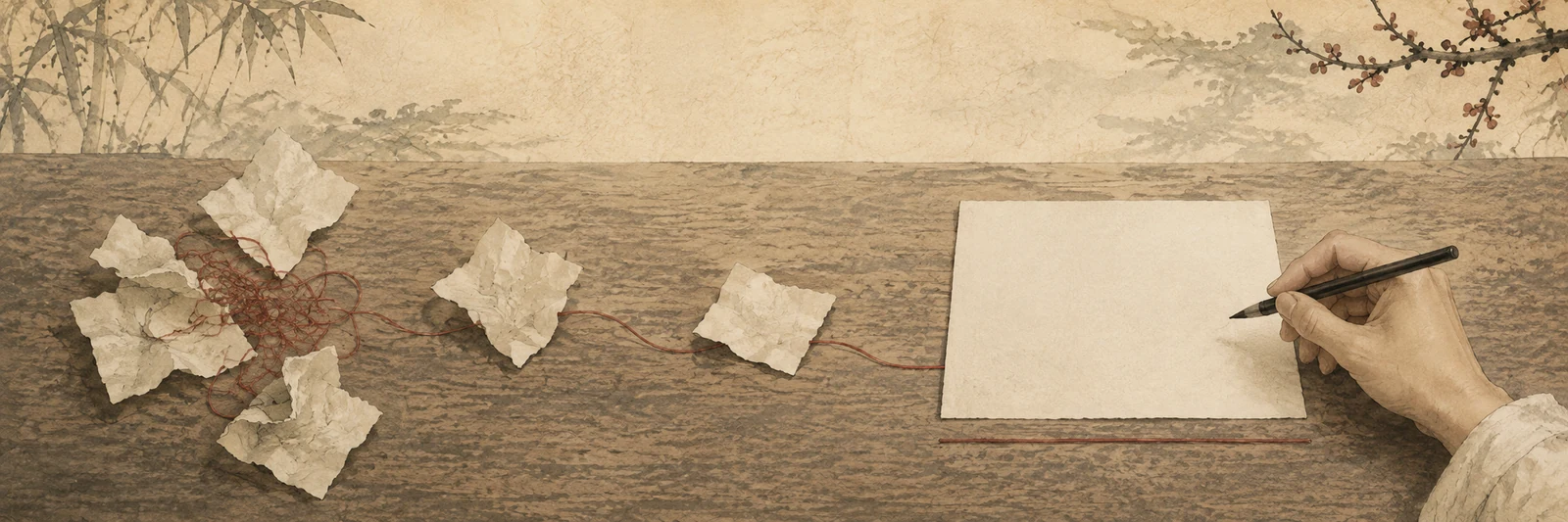
That does not mean you need perfect wording. It means you need a real point of uncertainty.
The I Ching works best when you bring it a live situation: a decision, a conflict, a relationship, a timing issue, or something that feels unclear and genuinely matters to you.
Start with the Real Situation
Why the Question Matters So Much
That means the reading depends in part on what situation you are actually asking about.
If the question is too loose, the reading may still be interesting, but it is harder to connect it to anything specific. If the question is grounded, the answer has something to attach to.
In other words, the I Ching does not only respond to your coins. It responds to the shape of your attention.
What Makes a Good I Ching Question?
You do not need a poetic question. You do not need the "right" spiritual attitude. You just need to know what you are actually asking.
Strong questions often sound like this:
- What should I understand about this relationship right now?
- What is the best way to approach this conflict?
- What does this situation require from me?
- What is the likely direction of things if I move forward with this plan?
- What am I not seeing clearly in this decision?
These questions work because they point to something real while leaving room for the I Ching to show pattern, movement, and condition.
Questions That Are Too Vague
For example:
- What will happen to me?
- What does my future look like?
- Will everything be okay?
- Tell me about my life.
These questions are understandable, but they are so wide that the reading can become difficult to use.
The problem is not that the I Ching cannot answer them. The problem is that they often produce readings that feel abstract because the question itself has no clear boundaries.
A better move is to narrow the question to one real situation.
Instead of "What will happen to me?" try: "What should I understand about my work situation right now?" Or: "What is the likely direction of this relationship if I continue as I am?"
Questions That Lead to Better Readings
Questions That Work Well with the I Ching
It is often most helpful when the issue is not just "What will happen?" but:
- What kind of moment is this?
- What is changing here?
- What is the wise response?
- What attitude fits the situation?
- What am I missing?
This is one reason the I Ching feels different from more direct systems. It often gives its best answers by showing the structure of the situation, not by flattening it.
Open-Ended Questions Usually Work Better
But open-ended questions often lead to better readings.
That is because the I Ching works in patterns, conditions, and movement. A simple yes-or-no format can sometimes compress a more complicated situation into a question that is too narrow.
Instead of asking "Should I quit my job?" you might ask:
- What should I understand about leaving my job now?
- What is the likely direction if I resign at this time?
- What does this situation require before I act?
These versions still address the same issue, but they give the reading more room to be specific and useful.
Do Not Phrase the Question to Force the Answer
For example:
- Why is leaving obviously the right choice?
- Why is this person secretly the one for me?
- When will this definitely work out?
Questions like these are less about inquiry and more about seeking confirmation.
The I Ching is more useful when you are actually willing to see the situation, not just get permission for what you already want.
That does not mean you need to be perfectly neutral. It means the question should leave some space for truth.
Keep It to One Issue If Possible
"Should I leave my job, move cities, break up with my partner, and start a business this year?" is really four questions, not one.
If you combine too much, the reading can become hard to interpret because you do not know what it is primarily addressing.
Usually, it is better to separate them:
- What should I understand about leaving my job?
- What is the right approach to moving this year?
- What is the state of this relationship right now?
One question does not need to explain your whole life. It only needs to identify the situation you want insight into.
Ask About Your Role, Not Just the Result
Instead of asking "Will this relationship work out?" you could ask:
- What is the dynamic in this relationship right now?
- What should I understand about my role in this situation?
- What approach is wise here?
This often produces a better reading because it puts the focus on something you can actually understand and respond to.
The I Ching is often strongest when it helps clarify stance, timing, and behavior. For relationship-specific examples, this pairs well with a love reading.
A Simple Formula for Better I Ching Questions
If you are not sure how to phrase your question, these templates work well. They are simple, flexible, and usually give the reading enough structure to become meaningful.
What should I understand about this situation right now?
A strong general-purpose format. Useful when you know the situation but do not yet know what to focus on.
What is the best way to approach this situation?
Best for conflict, relationships, or complex decisions where the issue is not just outcome, but behavior.
What is the likely direction if I move forward with this choice?
Useful when you want to understand direction rather than demand certainty.
What am I not seeing clearly about this situation?
Excellent when you feel stuck, emotionally tangled, or worried you are missing something obvious.
What does this moment require from me in this situation?
One of the best formulas overall. It invites a reading about timing, stance, and appropriate action.
Make sure it is the real question
You may think you are asking: "Should I take this opportunity?" But underneath that, the real question may be: Am I ready for the cost of this choice? Am I trying to escape something? Do I actually want this, or just the idea of it? Am I pushing because I am afraid to wait?
A short pause before casting can help. You do not need a ritual. Just take a moment and ask yourself whether the question you are about to bring is the real one.
Often that small correction makes the reading much sharper.
Should You Repeat the Same Question?
If you ask the same question again and again because you dislike the answer or feel uncertain, the reading often becomes noisier rather than clearer.
It is usually better to ask once, read carefully, sit with it, and only return later if the situation has genuinely changed or a distinct new question has emerged.
The I Ching tends to reward sincerity more than repetition.
Examples of Strong I Ching Questions
- What should I understand about this new job opportunity?
- What is the best way to handle this tension with my partner?
- What is the likely direction of this project if I continue?
- What does this moment require from me in regard to my health?
- What am I not seeing clearly about this friendship?
- Is this the right time to make a move, or is patience wiser?
These questions are focused, open, and tied to real situations.
If you already know your question and want to move into the actual process, read How an I Ching Reading Works next.
Can I ask the I Ching a yes-or-no question?
Yes. But open-ended questions often produce richer readings because they leave room for the I Ching to show pattern and condition rather than compressing everything into a single verdict.
Can I ask about another person?
You can ask about a situation involving another person, but it is usually better to frame the question from your own perspective. Ask about the dynamic, your role, the likely direction, or the best approach — not about controlling what someone else will do.
How specific should my question be?
Specific enough to point to one real situation, but open enough to allow insight. If the question feels so broad it could mean ten different things, narrow it. If it feels like it already contains the answer, loosen it.
What if I don't know how to phrase my question?
Start with a simple template and fill in your situation: "What should I understand about [your situation] right now?" That one phrasing works for almost any question. You do not need elegant wording — just honesty and enough clarity to identify what you are really asking about.
Can I ask more than one question in the same reading?
Usually, no. One reading works best when it is anchored to one issue. If you have multiple questions, separate them and ask them one at a time.
Ask for understanding, not just certainty
Choose one real situation. Keep the question focused. Avoid making it so broad that it means everything, or so leading that it leaves no room for insight.
In general, the best I Ching questions are not the ones that demand certainty. They are the ones that invite understanding.
Ask what is happening. Ask what is changing. Ask what kind of response the moment calls for.
That is usually where the I Ching becomes most useful.
Have a question in mind?
Cast your own coins, enter the result, and get a full reading of the hexagram that answers it.
Cast a reading →How to Ask the I Ching a Question
A good I Ching reading begins before the coins are tossed. It begins with the question.
That does not mean you need perfect wording. It means you need a real point of uncertainty.
The I Ching works best when you bring it a live situation: a decision, a conflict, a relationship, a timing issue, or something that feels unclear and genuinely matters to you.
Start with the Real Situation
Why the Question Matters So Much
If the question is too loose, the reading may still be interesting, but it is harder to connect it to anything specific. If the question is grounded, the answer has something to attach to.
The I Ching does not only respond to your coins. It responds to the shape of your attention.
What Makes a Good I Ching Question?
You do not need a poetic question. You just need to know what you are actually asking.
Good examples include: What should I understand about this relationship right now? What is the best way to approach this conflict? What am I not seeing clearly in this decision?
Questions That Are Too Vague
These questions are understandable, but they are so wide that the reading can become difficult to use.
A better move is to narrow the question to one real situation. Instead of "What will happen to me?" try "What should I understand about my work situation right now?"
Questions That Lead to Better Readings
Questions That Work Well with the I Ching
It is often most helpful when the issue is not just "What will happen?" but: What kind of moment is this? What is changing here? What is the wise response?
It often gives its best answers by showing the structure of the situation, not by flattening it.
Open-Ended Questions Usually Work Better
The I Ching works in patterns, conditions, and movement. A simple yes-or-no format can compress a more complicated situation into something too narrow.
Instead of "Should I quit my job?" ask: "What should I understand about leaving my job now?"
Do Not Phrase the Question to Force the Answer
The I Ching is more useful when you are actually willing to see the situation. The question should leave some space for truth.
Keep It to One Issue If Possible
Usually it is better to separate them. One question does not need to explain your whole life. It only needs to identify the situation you want insight into.
Ask About Your Role, Not Just the Result
The I Ching is often strongest when it helps clarify stance, timing, and behavior. For relationship-specific examples, this pairs well with a love reading.
A Simple Formula for Better I Ching Questions
If you are not sure how to phrase your question, these templates work well.
What should I understand about this situation right now?
A strong general-purpose format. Useful when you know the situation but do not yet know what to focus on.
What is the best way to approach this situation?
Best for conflict, relationships, or complex decisions where the issue is not just outcome, but behavior.
What is the likely direction if I move forward with this choice?
Useful when you want to understand direction rather than demand certainty.
What am I not seeing clearly about this situation?
Excellent when you feel stuck, emotionally tangled, or worried you are missing something obvious.
What does this moment require from me in this situation?
One of the best formulas overall. It invites a reading about timing, stance, and appropriate action.
Make sure it is the real question
You may think you are asking: "Should I take this opportunity?" But underneath that, the real question may be: Am I ready for the cost of this choice? Am I trying to escape something? Do I actually want this, or just the idea of it?
A short pause before casting can help. Often that small correction makes the reading much sharper.
Should You Repeat the Same Question?
If you ask the same question again and again because you dislike the answer or feel uncertain, the reading often becomes noisier rather than clearer.
The I Ching tends to reward sincerity more than repetition.
Examples of Strong I Ching Questions
- What should I understand about this new job opportunity?
- What is the best way to handle this tension with my partner?
- What is the likely direction of this project if I continue?
- What does this moment require from me in regard to my health?
- What am I not seeing clearly about this friendship?
- Is this the right time to make a move, or is patience wiser?
If you already know your question and want to move into the actual process, read How an I Ching Reading Works next.
Can I ask the I Ching a yes-or-no question?
Yes. But open-ended questions often produce richer readings because they leave room for the I Ching to show pattern and condition rather than compressing everything into a single verdict.
Can I ask about another person?
You can ask about a situation involving another person, but it is usually better to frame the question from your own perspective. Ask about the dynamic, your role, the likely direction, or the best approach — not about controlling what someone else will do.
How specific should my question be?
Specific enough to point to one real situation, but open enough to allow insight. If the question feels so broad it could mean ten different things, narrow it. If it feels like it already contains the answer, loosen it.
What if I don't know how to phrase my question?
Start with a simple template and fill in your situation: "What should I understand about [your situation] right now?" That one phrasing works for almost any question. You do not need elegant wording — just honesty and enough clarity to identify what you are really asking about.
Can I ask more than one question in the same reading?
Usually, no. One reading works best when it is anchored to one issue. If you have multiple questions, separate them and ask them one at a time.
Ask for understanding, not just certainty
In general, the best I Ching questions are the ones that invite understanding.
Ask what is happening. Ask what is changing. Ask what kind of response the moment calls for.
Have a question in mind?
Cast your own coins, enter the result, and get a full reading of the hexagram that answers it.
Cast a reading →