What Are Changing Lines
in the I Ching?
A beginner’s guide to one of the most important — and most misunderstood — parts of an I Ching reading.
Why Changing Lines Confuse Beginners
You ask a question, toss the coins six times, build a hexagram — and then suddenly you are told that one or more lines are "changing," and that your reading may involve not just one hexagram, but two. For beginners, this can make the whole system seem more mysterious than it really is.
But the basic idea is simple: Changing lines show where movement is happening inside a situation.
They are one of the reasons the I Ching is called the Book of Changes. A reading is not only about what a situation is; it is also about what in that situation is shifting, weakening, emerging, or turning into something else.
Once you understand that, changing lines start to feel less like a complication and more like the heart of the method.
What Is a Line in the I Ching
Each line is either yang (阳) — a solid line, representing active, expansive energy — or yin (阴) — a broken line, representing receptive, yielding energy.
Together, those six lines form a hexagram, and each hexagram represents a particular pattern or condition. There are 64 hexagrams in total, covering the full range of human experience.
When you cast with coins, however, not every line is treated the same way. Some lines are considered stable, and some are considered changing.
That difference is where the depth of the I Ching lives.
What Exactly Is an I Ching Changing Line
When you toss three coins, if all three land on the same side, the resulting line is changing. The two cases are mirror images:
Three heads gives you a changing yang line — yang at its peak, about to turn into yin.
Three tails gives you a changing yin line — yin at its peak, about to turn into yang.
So a changing yang line flips to yin in the second hexagram, and a changing yin line flips to yang. (If you cast on 易經 Oracle, this is worked out for you — you just tap heads or tails for each coin.)
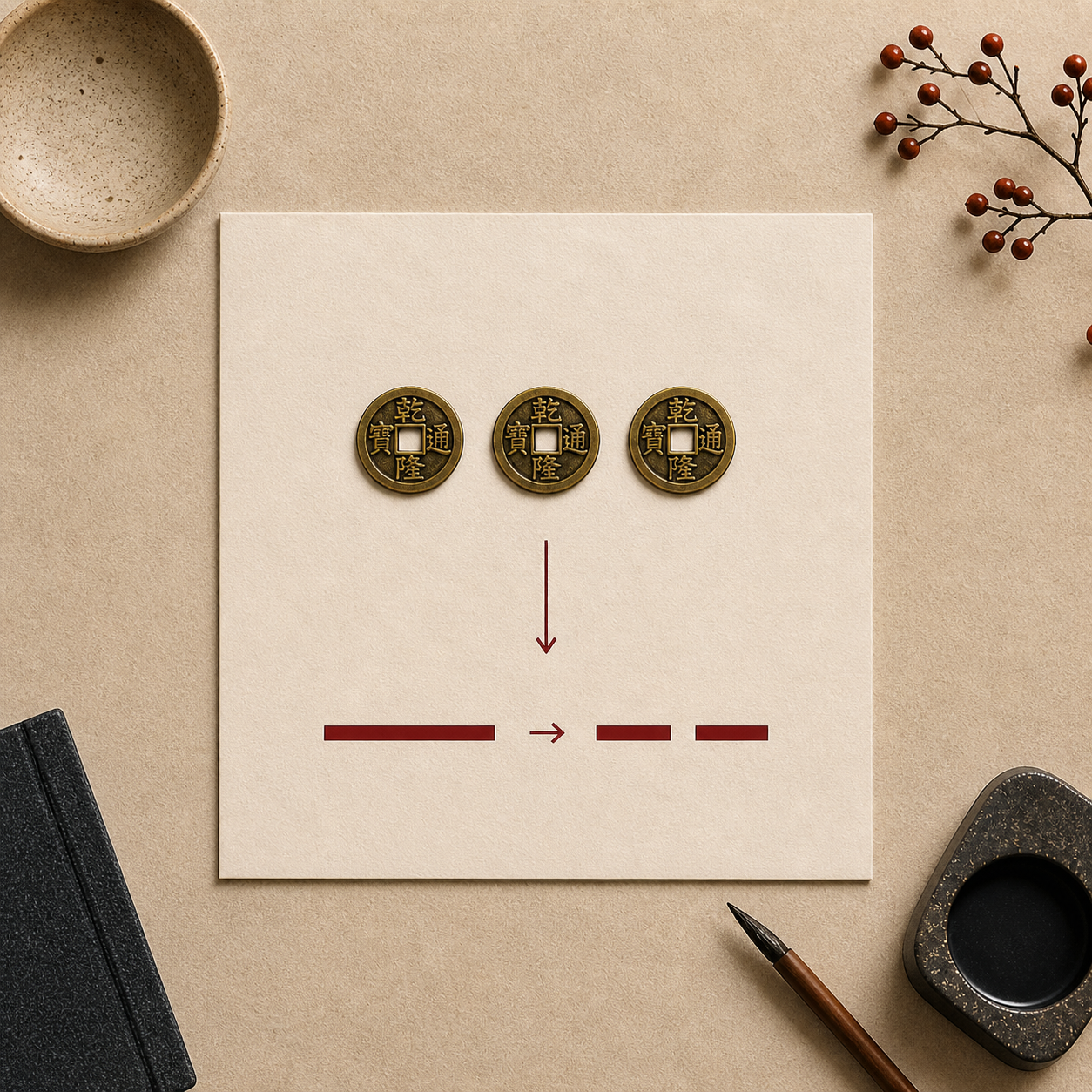
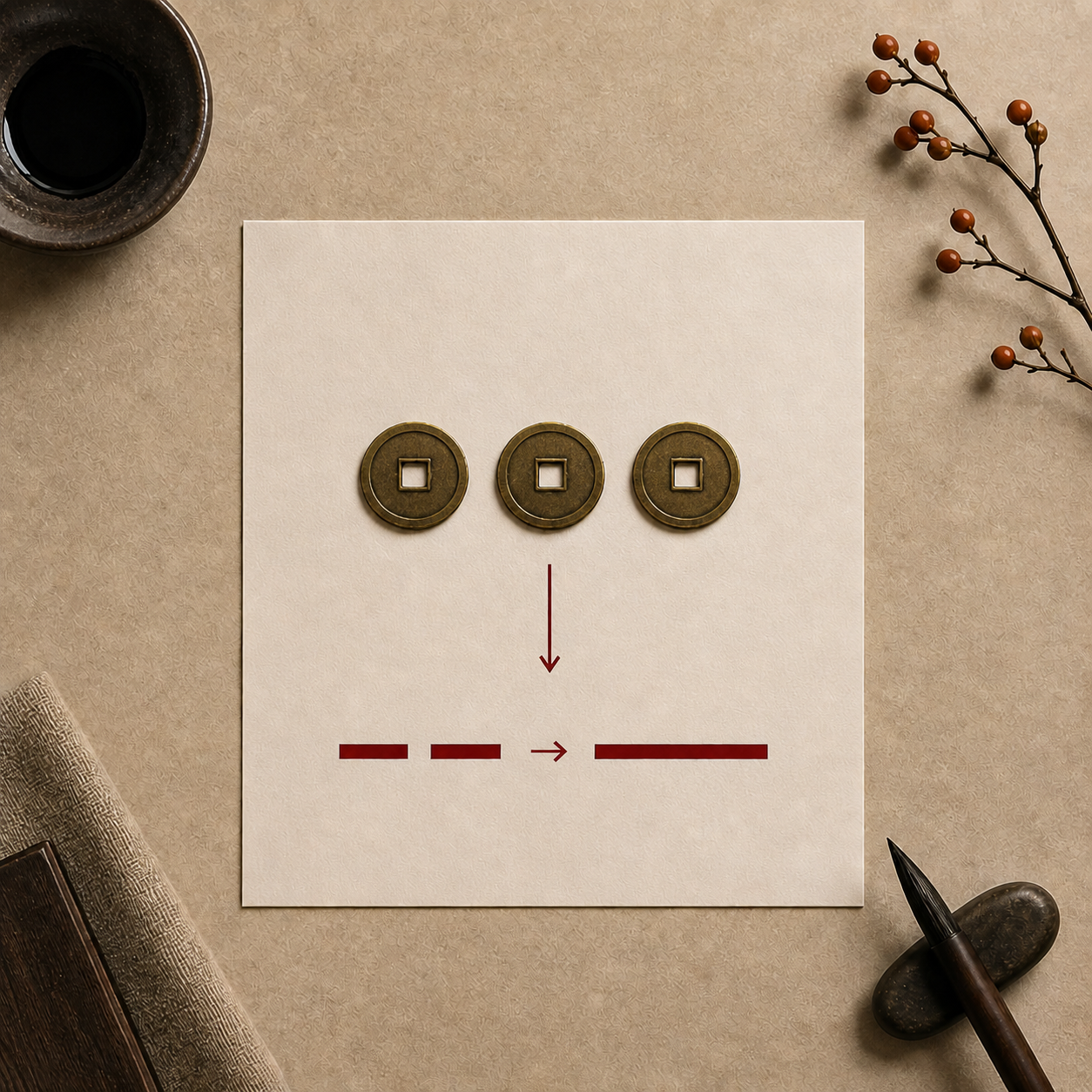
That means the line does not only describe the present state of the situation. It also points to transition.
This is why a reading with changing lines can generate a second hexagram. The first hexagram shows the current pattern. The changed hexagram shows what the situation may be moving toward — or what appears once that active element has shifted.
Why Do Changing Lines Matter
You are rarely asking, "What is this?" You are usually asking something closer to: What is happening here? What is changing? What should I pay attention to? Where is this going? What kind of response does this moment require?
Changing lines help answer those questions.
Without them, a hexagram gives you a broad pattern. With them, the reading becomes more precise. It shows where the tension is, where the turning point is, or which part of the situation is unstable.
That is often where the reading becomes most useful.
Are Changing Lines "Good" or "Bad"
A changing line does not simply mean something good is happening, and it does not simply mean trouble either. It means movement.
Sometimes movement is welcome. Sometimes it is stressful. Sometimes it is necessary. Sometimes it shows that a situation cannot stay as it is.
The I Ching is generally less interested in labeling change as good or bad in the abstract, and more interested in showing whether the movement is timely, premature, dangerous, productive, pressured, ripening, or incomplete.
So when you see a changing line, the better question is not "Is this bad?" but: What is shifting here, and what does that shift ask of me?
How Changing Lines Affect Your Reading
When a line changes, it gives you an extra layer of interpretation. A full reading may involve three levels:
The Primary Hexagram
The overall situation — the larger pattern, atmosphere, or condition you are asking about.
The Changing Line Text
The most active point inside the situation. It often shows a pressure point, a turning point, a warning, or a clue about what is specifically in motion.
The Resulting Hexagram
What emerges when those changing lines complete their transformation. Not always a fixed prediction, but it often suggests direction, outcome, or the next phase.
How Many Changing Lines?
No Changing Lines
For beginners, these readings can actually be easier because there are fewer moving parts.
One Changing Line
The overall hexagram gives context, but the changing line tells you exactly where to look.
Multiple Changing Lines
Different traditions handle this differently, but the core insight is the same: the more changing lines, the less fixed the situation is likely to be.
Do Changing Lines Predict the Future
They do not function like "this will definitely happen on Tuesday." Instead, they show directional movement inside a situation.
A changing line can indicate that the current state is unstable, that a shift is already underway, or that one pattern is turning into another. That is different from giving a rigid promise about the future.
In this sense, changing lines are often more useful than blunt prediction. They help you understand not just where things might go, but how change is happening.
A Practical Way to Think About Changing Lines
If the hexagram describes the larger situation, the changing lines show where that situation is beginning to move.
Sometimes they mark friction. Sometimes growth. Sometimes reversal. Sometimes the moment where pushing harder stops working and a different response is needed.
That is why they matter so much. They move the reading from general symbolism to something more alive and specific.
Why Changing Lines Often Land the Hardest
That is because the primary hexagram describes the whole landscape, but the changing lines often touch the exact pressure point: the emotional hinge, the unstable assumption, the badly timed action, the ripening possibility, the place where things are quietly turning.
They often answer the question beneath the question.
What's the difference between changing lines and moving lines?
They are the same thing. Changing lines and moving lines are both used in English I Ching translations to describe lines that are actively transforming during a reading.
How do changing lines appear when casting coins?
When you toss three coins, if all three land on the same side the line is changing: three heads is a changing yang line (it becomes yin), and three tails is a changing yin line (it becomes yang). Any mix of heads and tails gives a stable line. Each of the six tosses produces one line of the hexagram.
Can a hexagram have all six lines changing?
Yes, though it's rare. When all six lines change, the resulting hexagram is the exact opposite of the first. Some traditions read this as a complete inversion of the situation.
Do I need to interpret every changing line individually?
Not always. Many readers focus on the most relevant changing line — usually the one that resonates most clearly with the question — while still considering the resulting hexagram for direction.
Do online I Ching readings include changing lines?
Yes — if the reading is based on a real cast. On 易經 Oracle, you cast your own coins first, then the site helps interpret the resulting hexagram, including any changing lines.
Final Thoughts
They show that a reading is not only about naming a condition — but about tracing transformation within it.
If the hexagram tells you what kind of moment this is, the changing lines help show what in that moment is actively shifting.
And that is often the difference between a reading that feels abstract and one that feels alive.
Want to see changing lines in a real reading?
Cast your hexagram with a real question and see what comes up — including any lines in motion.
Cast a reading →What Are Changing Lines in the I Ching?
A beginner’s guide to one of the most important — and most misunderstood — parts of an I Ching reading.
Why Changing Lines Confuse Beginners
But the basic idea is simple: Changing lines show where movement is happening inside a situation.
They are one of the reasons the I Ching is called the Book of Changes. Once you understand that, changing lines start to feel less like a complication and more like the heart of the method.
What Is a Line in the I Ching
Together, those six lines form a hexagram representing a particular pattern. There are 64 hexagrams in total.
When you cast with coins, some lines are considered stable and some are changing. That difference is where the depth of the I Ching lives.
What Exactly Is an I Ching Changing Line
This means the line points not just to the present, but to transition. A reading with changing lines can generate a second hexagram — showing what the situation may be moving toward.
Why Do Changing Lines Matter
Without changing lines, a hexagram gives you a broad pattern. With them, the reading becomes more precise — showing where the tension or turning point is.
Are Changing Lines "Good" or "Bad"
Sometimes movement is welcome. Sometimes stressful. Sometimes necessary. The I Ching is more interested in showing whether the movement is timely, premature, productive, or incomplete.
The better question is not "Is this bad?" but: What is shifting here, and what does that shift ask of me?
How Changing Lines Affect Your Reading
A full reading with changing lines may involve three levels:
The Primary Hexagram
The overall situation — the larger pattern, atmosphere, or condition you are asking about.
The Changing Line Text
The most active point inside the situation. It often shows a pressure point, a turning point, a warning, or a clue about what is specifically in motion.
The Resulting Hexagram
What emerges when those changing lines complete their transformation. Not always a fixed prediction, but it often suggests direction, outcome, or the next phase.
How Many Changing Lines?
No Changing Lines
One Changing Line
Multiple Changing Lines
Do Changing Lines Predict the Future
A changing line can indicate that the current state is unstable, that a shift is underway, or that one pattern is turning into another. They help you understand not just where things might go, but how change is happening.
A Practical Way to Think About Changing Lines
Sometimes they mark friction. Sometimes growth. Sometimes reversal. Sometimes the moment where pushing harder stops working and a different response is needed.
They move the reading from general symbolism to something more alive and specific.
Why Changing Lines Often Land the Hardest
The primary hexagram describes the whole landscape, but changing lines often touch the exact pressure point: the emotional hinge, the unstable assumption, the place where things are quietly turning.
They often answer the question beneath the question.
What's the difference between changing lines and moving lines?
They are the same thing. Changing lines and moving lines are both used in English I Ching translations to describe lines that are actively transforming during a reading.
How do changing lines appear when casting coins?
When you toss three coins, if all three land on the same side the line is changing: three heads is a changing yang line (it becomes yin), and three tails is a changing yin line (it becomes yang). Any mix of heads and tails gives a stable line. Each of the six tosses produces one line of the hexagram.
Can a hexagram have all six lines changing?
Yes, though it's rare. When all six lines change, the resulting hexagram is the exact opposite of the first. Some traditions read this as a complete inversion of the situation.
Do I need to interpret every changing line individually?
Not always. Many readers focus on the most relevant changing line — usually the one that resonates most clearly with the question — while still considering the resulting hexagram for direction.
Do online I Ching readings include changing lines?
Yes — if the reading is based on a real cast. On 易經 Oracle, you cast your own coins first, then the site helps interpret the resulting hexagram, including any changing lines.
Final Thoughts
They show that a reading is not only about naming a condition — but about tracing transformation within it.
If the hexagram tells you what kind of moment this is, the changing lines help show what in that moment is actively shifting.
And that is often the difference between a reading that feels abstract and one that feels alive.
Want to see changing lines in a real reading?
Cast your hexagram with a real question and see what comes up — including any lines in motion.
Cast a reading →