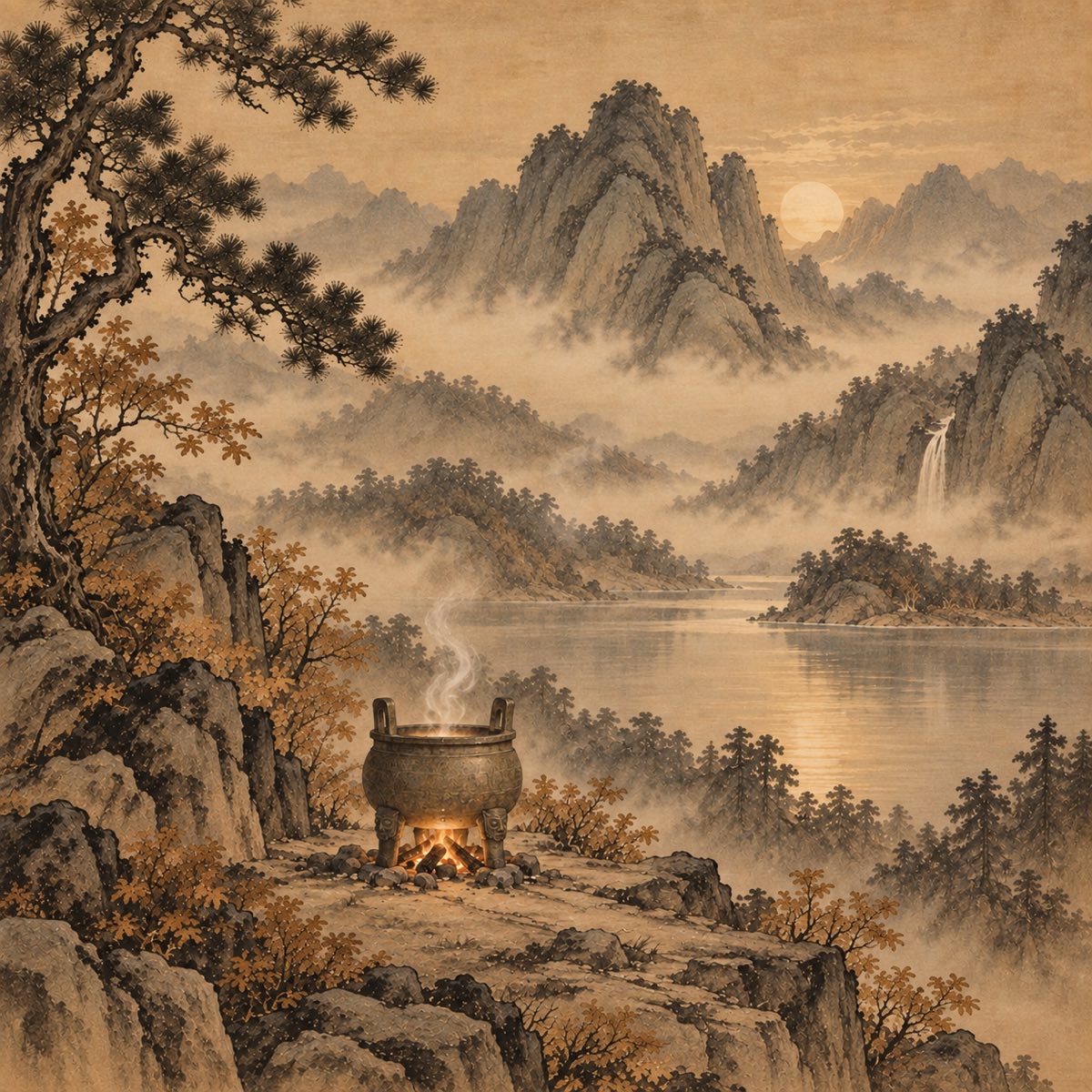
A bronze cauldron held above a steady wood fire — Hexagram 50, The Cauldron.
Hexagram 50 · The Cauldron · 火风鼎

鼎 Dǐng

The Cauldron

Hexagram 50, The Cauldron (鼎卦, Dǐng), concerns the vessel that receives raw material and transforms it into nourishment, culture, or shared value. Wood and wind below feed fire above, creating sustained heat rather than a sudden blaze. This reading favors building a sound container for meaningful work, placing capable people correctly, and refining what has already begun. It cautions against responsibility that exceeds support, valuable contents left unused, and structures too weak to carry what they hold.

The Essence

What does Hexagram 50 mean?

Hexagram 50 is called Dǐng (鼎), the ancient bronze ritual cauldron used to prepare food and make offerings. It was not merely cookware: the vessel also carried associations of authority, order, and the shared practices through which a community expressed what it valued. The hexagram is commonly translated as The Cauldron or The Vessel.

Its shape was traditionally seen in the six lines: legs below, the belly of the vessel, its ears, and the carrying bar above. Wind or wood stands beneath fire, suggesting fuel feeding a controlled flame. What enters the vessel is not simply stored; it is transformed through sustained heat.

The Cauldron often appears when:

  • a new structure must hold and mature what change has made possible,
  • talent, knowledge, or resources need the right role and container,
  • nourishment is available but not yet accessible,
  • or responsibility has grown beyond the strength of its supports.

Within the I Ching, Dǐng asks not only what is being created, but what kind of vessel, practice, and leadership can refine it into lasting value.

The core meaning of The Cauldron

At its core, Hexagram 50 is about transformation through a sound vessel. Fire can cook only because the cauldron holds its contents at the right distance and its legs carry the weight. Structure and transformation are inseparable: without heat the contents remain raw; without a stable container the meal is lost.

The Image says that the noble person corrects their position and consolidates their mandate. People, responsibilities, and purposes need to be properly placed. This is not a defense of status for its own sake. Position matters because the work depends on who carries, holds, and tends each part.

The changing lines examine the vessel from bottom to top. It is first overturned to clear out what is stale, then filled, obstructed, broken, repaired, and finally fitted with a jade carrying bar. The sequence asks whether valuable material can be prepared, accessed, and carried without the structure failing beneath it.
A Note on Reception

What it feels like to receive Hexagram 50

Receiving Hexagram 50 can feel like entering the stage after a major decision when inspiration must become practice. The dramatic change may already have happened. Now the question is whether there is a reliable place for the new work, relationship, identity, or responsibility to develop.

There may be real promise here. The Judgment is brief and strongly favorable. Something valuable can be nourished and brought to maturity. But the image of the vessel directs attention away from excitement and toward capacity: are the legs secure, are the handles usable, is the heat steady, and can what is being prepared actually be shared?

This can expose an uncomfortable mismatch. You may possess good material but lack access, support, or a role that lets it be used. Or others may be placing important weight on a structure that has not been strengthened.

Dǐng invites patient confidence. Clear out what is spoiled, repair the container, and tend the process. Transformation happens through sustained conditions, not through repeatedly overturning the vessel to prove that change has begun.

Contextual Interpretations

Hexagram 50 in different areas of life

Love & Relationships

In love, Hexagram 50 favors a relationship that can nourish both people through stable practices, shared values, and mature care. Attraction or a major decision may have brought the bond into a new form; the work now is to create a container in which trust and intimacy can deepen.

In a love reading, look at the structure beneath the feeling. Do both people have usable ways to communicate, repair conflict, share responsibility, and make room for what the relationship is becoming? Valuable affection can remain “uneaten” when access is blocked or when roles prevent honest exchange.

The broken leg in Line 4 is a warning against loading the bond with more responsibility than its supports can carry. Moving in, merging finances, caregiving, or making a major commitment may be meaningful, but the foundation must be strengthened first. The upper lines are favorable because the vessel becomes both reliable and refined: steadiness makes deeper nourishment possible.

Career & Work

In career, Hexagram 50 favors building the structures through which talent, knowledge, and resources become useful work. It can describe a capable team, an institution, a craft, a teaching role, or a project that turns varied inputs into something of lasting value.

In a career reading, correct placement is central. Give responsibility to someone able to carry it; make expertise accessible; and ensure the processes holding important work are strong enough for the load. Line 3 shows valuable contents going unused because the handles have been altered and movement is blocked. Good work without a path to use or deliver it remains unrealized potential.

Line 4 offers the sharpest caution: when the legs break, the ruler's meal is spilled. A visible failure may come from structural weakness rather than lack of valuable content. Before accepting greater scope, check staffing, authority, maintenance, and decision support. Growth is favorable when the vessel is strengthened along with what it is asked to contain.

Money & Resources

Financially, Hexagram 50 favors resources placed inside a structure that can preserve, refine, and use them well. The emphasis is less on sudden acquisition than on the container: a sustainable budget, well-organized finances, dependable income process, or investment in tools and capabilities that produce value over time.

In a money reading, distinguish useful contents from the vessel holding them. A promising asset or income stream can still be undermined by poor terms, weak reserves, inaccessible funds, or responsibilities greater than available support. Strengthen the structure before placing more weight on it.

The cauldron also warns against resources that exist but cannot nourish anyone. Review whether money is trapped, poorly allocated, or maintained only for appearance. Clearing an obsolete expense or arrangement may be necessary before the vessel can be used properly. Favor durable capacity and well-supported stewardship over a prestigious commitment whose legs may fail.

Is Hexagram 50 a Yes or No?

For yes-or-no questions, Hexagram 50 supports what can be developed through a sound structure, capable stewardship, and sustained attention. It is favorable for building, refining, teaching, nourishing, or consolidating something with real value.

Its caution concerns capacity. If the proposed undertaking places important contents in a weak vessel, strengthen the foundation before proceeding. If resources or talent are present but inaccessible, repair the path by which they can be used. The changing line shows whether the moment involves clearing out the old, protecting valuable contents, removing an obstruction, preventing structural failure, or carrying the mature result.

The Six Moving Stages

The six changing lines

The six changing lines of Hexagram 50 inspect the cauldron as a working vessel. The first overturns it to empty what is stale. The second holds real substance and remains protected. The third has valuable food but unusable handles until conditions change. The fourth breaks a leg and spills an important meal. The fifth gains yellow ears and a golden bar; the top line a jade bar of exceptional balance. The sequence moves from clearing and obstruction toward reliable, refined capacity.

01

Overturning the Cauldron

Bottom line

初六:鼎颠趾,利出否,得妾以其子,无咎。

Turn the vessel over to remove what is stale before using it anew.

02

The Vessel Has Substance

Line 2

九二:鼎有实,我仇有疾,不我能即,吉。

Real substance is present and remains protected from interference.

03

The Handles Are Altered

Line 3

九三:鼎耳革,其行塞,雉膏不食,方雨亏悔,终吉。

Valuable contents remain unused while access is blocked; patience ends regret.

04

The Leg Breaks

Line 4

九四:鼎折足,覆公餗,其形渥,凶。

Insufficient support spills an entrusted provision and brings serious misfortune.

05

Golden Carrying Bar

Line 5

六五:鼎黄耳金铉,利贞。

Balanced fittings make the vessel dependable; sound constancy is favorable.

06

Jade Carrying Bar

Top line

上九:鼎玉铉,大吉,无不利。

Strength joined with refinement brings great good fortune and broad usefulness.

Learn more about how changing lines reshape a reading in I Ching Changing Lines.

Reflection

What this asks of you

If you receive Hexagram 50, look beyond the value of the contents to the condition of the vessel holding them. Let three questions test whether transformation can be sustained.

  1. 01 /

    What valuable material, knowledge, or relationship is ready to be refined rather than merely stored?

  2. 02 /

    Which support, role, or channel must be repaired so that what is present can actually be used?

  3. 03 /

    Is the vessel strong enough for the responsibility now being placed inside it?

Tend the vessel as carefully as its contents. What is valuable becomes nourishing only when it can be held, transformed, and carried.

Common Misunderstandings

What Hexagram 50 is not

“The Cauldron simply means abundance or a feast.” Not quite. The vessel may contain nourishment, but several lines focus on whether it can be cleaned, accessed, supported, and carried. Dǐng is about the conditions that transform valuable material into something usable, not merely the possession of plenty.

“Good intentions are enough if the contents are valuable.” Line 4 rejects this. When the leg breaks, the entrusted meal is spilled. Capacity, maintenance, and correct placement are moral as well as practical matters when others depend on the result. A worthy purpose does not excuse a structure unable to carry it.

“Transformation requires another dramatic break.” The inverse, Hexagram 49, Revolution, has already addressed the change of form. The Cauldron concerns what follows: sustained heat, proper roles, and a vessel capable of maturing the new order. Repeated disruption can prevent the very transformation the revolution was meant to make possible.

Related Patterns

Hexagrams related to Hexagram 50

Frequently Asked Questions

Is Hexagram 50 a good sign?

Yes, its Judgment is strongly favorable, and the upper lines culminate in great good fortune. It supports transformation, nourishment, capable leadership, and structures that turn valuable material into shared use. Its warnings concern blocked access and responsibilities placed on supports too weak to carry them.

What does Hexagram 50 mean in love?

In love, The Cauldron favors a bond that can deepen through stable practices, shared values, and mature care. It asks whether the relationship has a sound container for intimacy and responsibility. Strong feelings are valuable contents, but communication, repair, boundaries, and practical support determine whether those contents can truly nourish the bond.

Does Hexagram 50 mean yes or no?

It supports undertakings that can be held, refined, and carried by a sound structure. This is encouraging for building something meaningful or consolidating a transformation. It cautions against proceeding when responsibility exceeds support, important resources remain inaccessible, or the container needs repair before more weight is added.

What does the broken cauldron leg mean?

Line 4 shows the cauldron's leg breaking and the ruler's food being spilled. It warns that an entrusted task can fail when its supports are inadequate for the weight. In modern terms, check capacity, preparation, maintenance, and accountability before taking on work whose failure would affect others.

What is the Chinese name of Hexagram 50?

The Chinese name is Dǐng (鼎), an ancient three-legged bronze ritual vessel used for cooking and offerings. Its full name is 火风鼎, fire over wind or wood. The vessel became a symbol of transformation, nourishment, authority, and the cultural order able to carry shared value.

How are Hexagrams 50 and 49 related?

Hexagram 49, Revolution, and Hexagram 50 form an inverse pair. Revolution changes the old form; The Cauldron establishes the vessel that follows. Together they show that durable transformation needs both a legitimate break with what no longer works and a reliable structure that can nourish the new.

See Hexagram 50 in a reading of your own

Cast your own coins, enter the result, and receive a reading of the pattern in front of you — including any changing lines and the resulting hexagram.

Cast a reading →
← Back to all 64 hexagrams