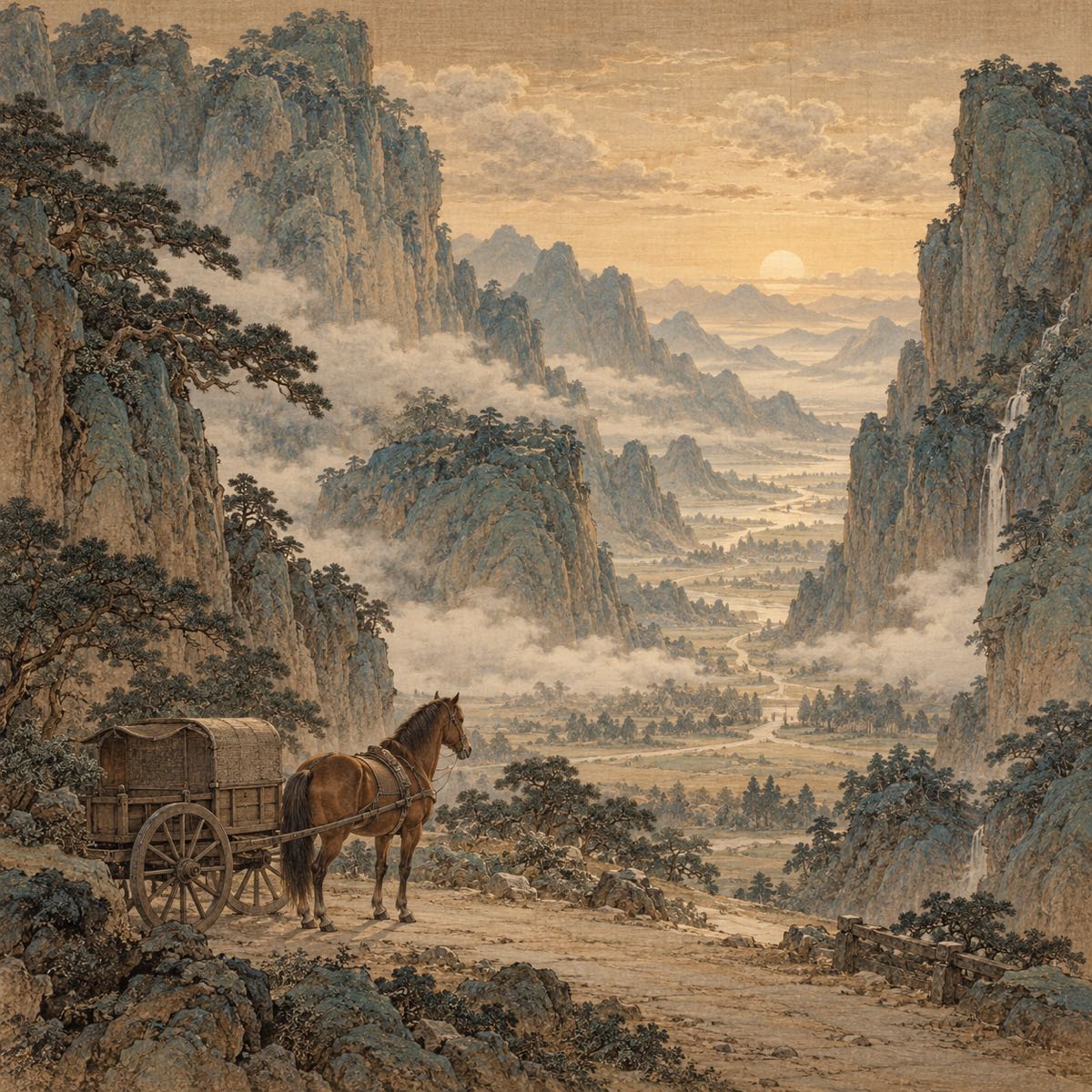
A harnessed horse and carriage waiting on a mountain road — Hexagram 26, Great Taming.
Hexagram 26 · Great Taming · 山天大畜

大畜 Dà xù

Great Taming

Hexagram 26, Great Taming (大畜卦, Dà Xù), describes strong energy being held, educated, and accumulated until it can serve a larger purpose. Heaven within mountain suggests immense force contained by a firm boundary. This reading favors preparation, learning from experience, and restraint that builds real capacity. It does not ask for indefinite delay: once skill, timing, and support are sufficient, the Judgment favors leaving the familiar and undertaking something consequential.

The Essence

What does Hexagram 26 mean?

Hexagram 26 is called Dà Xù (大畜), translated as Great Taming, Great Accumulating, or The Taming Power of the Great. Dà means great; xù can mean to store, nourish, rear, restrain, or accumulate. The title therefore holds two ideas together: powerful energy is checked, and that restraint allows something substantial to be cultivated.

Heaven stands within mountain. Heaven represents vigorous movement; mountain stops and contains. The image is not force being crushed, but force given a boundary strong enough to deepen it. The Image connects this process with studying the words and deeds of the past in order to accumulate virtue.

Great Taming often appears when:

  • ability is present but not yet adequately trained,
  • a delay can be used to gather knowledge, resources, or support,
  • raw force needs structure before it can be trusted,
  • or preparation is nearly ready to become meaningful action.

Within the I Ching, Dà Xù is more than waiting. The Judgment praises constancy, says it is fortunate not to eat at home, and favors crossing the great river. Stored strength is ultimately meant to leave private safety and become useful in a wider field.

The core meaning of Great Taming

At its core, Hexagram 26 concerns turning restraint into capacity. A pause is valuable when it develops judgment, skill, character, or material readiness. Mere hesitation does not qualify. The mountain contains Heaven so that its force can be cultivated rather than scattered.

The Judgment's “not eating at home” has traditionally been associated with moving beyond private support into public service or earning one's place through useful work. “Crossing the great river” then marks a consequential undertaking. Together, the images show a movement from disciplined accumulation toward participation in something larger.

The changing lines reveal how that movement matures. Early force must stop before danger. Next, the vehicle is deliberately disabled. Training follows; then harmful momentum is prevented at its beginning and redirected at its root. At the top, the road opens. Dà Xù asks not only whether you can hold power, but whether the holding is making it wiser and more usable.

A Note on Reception

What it feels like to receive Hexagram 26

Receiving Hexagram 26 can feel like having considerable energy with nowhere obvious to put it. You may know that you can act, yet encounter a boundary, delay, rule, or responsibility that prevents immediate release. The frustration is real because the force itself is not weak.

The reading changes the question from “Why am I being stopped?” to “What can this interval build?” A blocked launch may expose a missing skill. A postponed decision may create time to study precedent. A limit may keep ambition from becoming a costly mistake.

This is not a demand to remain contained forever. The later lines progressively replace external restraint with trained competence and intelligent prevention. By the top line, movement is no longer opposed: a broad road is available.

The emotional work is to distinguish productive containment from fear disguised as preparation. If the pause is increasing your ability to carry the next step, it serves the hexagram. If preparation has become an endless refuge from exposure, Great Taming asks what evidence would make you ready to leave home and cross.

Contextual Interpretations

Hexagram 26 in different areas of life

Love & Relationships

In love, Hexagram 26 favors emotional strength that can be held, understood, and expressed without overwhelming the relationship. Attraction or frustration may be powerful, but intensity alone does not determine the right pace.

In a love reading, the mountain's restraint can mean pausing before a declaration, argument, reunion, or commitment so that the motive becomes clearer. This is useful when urgency is being mistaken for intimacy. The pause should produce something: better listening, steadier boundaries, repaired trust, or a more realistic understanding of what each person can offer.

The middle lines show why early guidance matters. A young force is easier to shape before it becomes a destructive habit. Address contempt, avoidance, jealousy, or unequal responsibility near its source rather than relying on stronger restrictions later.

Great Taming does not endorse withholding affection as a way to gain control. Its restraint protects and educates power; it does not manipulate the other person. When care, skill, and mutual readiness have accumulated, the Judgment's outward movement supports taking a meaningful step rather than extending uncertainty for its own sake.

Career & Work

In career, Hexagram 26 strongly favors preparation that creates the capacity for larger responsibility. Training, research, reserves, mentorship, documentation, and familiarity with precedent can matter more now than visible speed.

The Image explicitly values learning from earlier words and actions. In a career reading, study what has already been tried: previous decisions, failed launches, experienced colleagues, customer evidence, or the history of the field. Accumulated knowledge becomes practical virtue when it changes how you act.

Early lines advise stopping when the present vehicle cannot safely carry the force behind it. That may mean delaying a launch, narrowing authority, or repairing a weak process. Later lines favor practice and preventive design: train the team, install safeguards, and remove incentives that repeatedly create trouble.

The Judgment also warns against keeping developed ability confined to private comfort. Once the foundation is real, a stretch assignment, public contribution, leadership role, or difficult crossing may be appropriate. Do not confuse readiness with certainty; consequential work still carries risk. The question is whether your accumulated capacity can now meet that risk responsibly.

Money & Resources

Financially, Hexagram 26 favors building reserves, knowledge, and disciplined control before making a consequential commitment. The image of accumulation naturally suits saving, but the deeper teaching is about making resources more governable and useful.

In a money reading, an early warning may call for stopping a purchase, investment, or expansion whose risk has become visible. Disabling the carriage can be wiser than relying on willpower while the vehicle keeps moving. Automatic limits, written criteria, insurance, due diligence, and adequate liquidity turn restraint into structure.

The middle lines favor working on causes rather than symptoms. If spending repeatedly breaks the plan, change the conditions that trigger it. If an investment depends on knowledge you do not yet possess, study or reduce the exposure rather than borrowing confidence from enthusiasm.

Accumulation is not hoarding for its own sake. The Judgment eventually supports leaving home and crossing the river: resources may be ready to fund useful work, education, a carefully tested venture, or another substantial purpose. Use them when preparation has made the risk proportionate—not merely because waiting has become uncomfortable.

Is Hexagram 26 a Yes or No?

For yes-or-no questions, Hexagram 26 supports preparation first and consequential action when that preparation is genuinely complete. It cautions against an immediate move if danger is already visible or the vehicle cannot carry the load.

This is not a fixed no. The Judgment favors crossing the great river, and the upper line opens into free passage. Ask what still needs to be learned, stored, trained, or prevented at its source. If those foundations are missing, pause. If capacity has been tested and the remaining hesitation is only attachment to safety, the reading may support moving beyond the familiar. The changing line shows where you are in that progression.

The Six Moving Stages

The six changing lines

The six changing lines of Hexagram 26 trace the gradual education of strong force over time. The first recognizes danger and stops. The second makes movement temporarily impossible by removing the carriage fitting. The third trains vigorously while maintaining difficult constancy. The fourth restrains a young bull before its horns become dangerous. The fifth redirects a boar's force at its source. At the top, containment has completed its work and Heaven's road opens. The sequence moves from imposed limits toward trained freedom.

01

Stop Before Danger

Bottom line

初九:有厉,利已。

Recognize the risk early; stopping now protects strength for later.

02

The Carriage Disabled

Line 2

九二:舆说輹。

Make premature movement impossible while the vehicle is not ready.

03

Training Good Horses

Line 3

九三:良马逐,利艰贞。曰闲舆卫,利有攸往。

Practice skill and protection diligently; prepared movement becomes favorable.

04

The Young Bull

Line 4

六四:童牛之牿,元吉。

Guide force at its beginning, before resistance becomes dangerous.

05

The Castrated Boar’s Tusk

Line 5

六五:豶豕之牙,吉。

The castrated boar’s tusk shows force redirected at its source.

06

Heaven’s Highway

Top line

上九:何天之衢,亨。

Accumulated capacity finds an open road; larger movement can succeed.

Learn more about how changing lines reshape a reading in I Ching Changing Lines.

Reflection

What this asks of you

If you receive Hexagram 26, examine whether the present limit is building capacity or merely postponing exposure. Three questions can show what the stored strength is for.

  1. 01 /

    What knowledge, practice, or safeguard would make this strength more trustworthy?

  2. 02 /

    Can I address the source of the recurring problem instead of restraining each symptom?

  3. 03 /

    What evidence would show that preparation is complete enough for a meaningful crossing?

Let the boundary educate the force it contains. Store strength for service, then leave the shelter when discipline has made a road through risk.

Common Misunderstandings

What Hexagram 26 is not

“Great Taming means I should suppress my ambition.” No. The hexagram contains Heaven, an image of tremendous creative force. Mountain does not erase that force; it gives it form. The goal is not self-denial but capacity strong enough to use ambition without being used by it.

“If I keep preparing, the right moment will eventually become risk-free.” No crossing of a great river is risk-free. Preparation reduces avoidable danger and builds competence, but the Judgment still points toward leaving familiar support. Endless research can become another way of refusing the test for which the preparation was made.

“Restraint always means applying tighter control.” The lines become subtler as they rise. Early movement is stopped, but later problems are prevented or redirected at their source. Mature restraint needs less force because it understands how momentum forms. The inverse, Hexagram 25, Innocence, provides the complementary correction: training should preserve directness and truth, not make every action calculating or artificial.

Related Patterns

Hexagrams related to Hexagram 26

Frequently Asked Questions

Is Hexagram 26 a good sign?

It is generally constructive, especially for learning, preparation, self-command, and building capacity for a significant undertaking. The early lines still warn of danger when force moves before it is ready. Its favorable promise is developmental: restraint and study make later movement possible, but they do not guarantee a particular outcome.

What does Hexagram 26 mean in love?

In love, Great Taming supports holding strong emotion without suppressing or weaponizing it. A pause may help clarify intention, establish boundaries, or repair the capacity for trust. The restraint should improve the relationship's ability to carry intensity. It should not become silent punishment, indefinite withholding, or a technique for controlling the other person's response.

Does Hexagram 26 mean yes or no?

It often means “not yet—prepare well,” followed by a possible yes when the necessary capacity exists. The Judgment favors a difficult crossing, so the hexagram is not fundamentally opposed to action. Look to the changing line: lower lines stop premature movement, middle lines train and redirect force, and the top line indicates an open road.

What does Hexagram 26 mean with changing lines?

The moving line identifies the present stage of restraint. You may need to stop at visible danger, disable a weak vehicle, train diligently, prevent a problem early, redirect its root cause, or recognize that preparation has finished and passage is open. The relating hexagram then adds context for how this stored strength is changing.

What is the Chinese name of Hexagram 26?

The Chinese name is Dà Xù (大畜). Dà means great, while xù can mean to accumulate, store, nourish, rear, or restrain. “Great Taming” emphasizes disciplined control; “Great Accumulating” emphasizes what that control develops. Both translations belong to the same pattern of cultivation. Its full name, 山天大畜, means mountain over Heaven.

What does “not eating at home” mean in Hexagram 26?

The phrase has traditionally been read as moving beyond private provision into useful service, often with support or recognition in a wider social role. In a modern reading, it can describe allowing developed ability to leave the safety of preparation and contribute publicly. It is not a literal instruction to avoid one's home or meals.

See Hexagram 26 in a reading of your own

Cast your own coins, enter the result, and receive a reading of the pattern in front of you — including any changing lines and the resulting hexagram.

Cast a reading →
← Back to all 64 hexagrams